Schizophrenia Explained: Hallucinations, Delusions & Early Warning Signs
Are you curious about schizophrenia and how it affects the mind? This full-length podcast explores the complex world of schizophrenia and psychosis, breaking down myths, symptoms, and the science behind the condition.
In this episode, Dr. Sunil M & Dr. Priya Raghavan discuss:
- What hallucinations and delusions really mean
- The difference between hallucinations vs. normal thoughts
- Types of delusions (bizarre, religious, and more)
- How to recognize early warning signs in loved ones
- Why brain scans, blood tests, and evaluations are important for diagnosis
- Why schizophrenia often appears in adolescence or early adulthood
- Differences in onset between men and women
- How families and clinicians can support patients through recovery
Dr. Priya provides real-world insights into psychiatry, mental health care, and the human side of living with schizophrenia.
Whether you’re curious about mental health, supporting someone you love, or studying psychology, this conversation is an eye-opening deep dive.
👉 Don’t forget to like, share, and subscribe for more episodes on mental health and wellbeing.
Visit our website: https://www.cadabams.org/ for more helpful resources on mental health and wellness.
Transcript
Cadabam’s Insights: Understanding Schizophrenia
Welcome to Cadabam's Insights, where serious conversations happen.
Today, we are going to dive deep into one of the most serious topics of psychiatry and mental health which matters to millions of people — Schizophrenia.
Schizophrenia is a very serious and challenging illness that many people go through.
Today, we will understand what schizophrenia is all about — how to identify it, how to recognize it, what are the signs and symptoms that you generally see with a person having schizophrenia, what are the treatment options, and we will also break the myths that are commonly seen about schizophrenia.
To do this, to talk about schizophrenia, we have a wonderful guest — Dr. Priya Raghavan.
She's a very senior psychiatrist. She had her initial training in medicine in Bangalore, after which she went to the UK to specialize in psychiatry.
Not only did she specialize in psychiatry, she also specialized in a subspecialty of psychiatry — she is a super-specialist in psychiatry.
After her stint in the UK, her motherland was calling — she came back to India and she's serving the people of our country with Cadabams.
Introduction
I welcome Dr. Priya Raghavan for today's conversation on schizophrenia.
Host: Welcome Dr. Priya. And not wasting much time, let's directly get into talking about schizophrenia.
So Dr. Priya, you've finished your medicine here in India and then you went to the UK. You did your postgraduation and chose psychiatry as your specialty and also you did your super specialization in psychiatry when in India we had not heard that there can be a super specialty.
Dr. Priya’s Journey into Psychiatry
Dr. Priya:
So I did my MBBS, my undergraduation here in India in KIM's Bangalore. And at that time I remember doing a 10-day posting in mental health and psychiatry as part of your internship you're supposed to do.
And if I go back in time, if I remember right, psychiatry was also in its very early stages in India.
Yes, it was practiced up to a certain extent, but the acceptance by people was still at a very, very low level.
Resources were good — there were teams formed, be it for inpatient or outpatient — so it was a completely different ballgame.
I had not seen that level of organization and level of resources if you like.
So along with that came the exposure, of course, to mentally ill patients. We saw a wide variety of illnesses.
And of course, after your post-graduation — what you call MRC Psych, which is roughly the equivalent of a diploma in psychiatry here — then you, you know, if you want, you can go and specialize.
We call it specialty there; here we call it super specialization.
So I chose old age psychiatry. So I'm actually a specialist in old age psychiatry with, you know, and I have of course postgraduate qualification for general psychiatry.
First Impressions of Schizophrenia
Host: When was the first time you heard about schizophrenia, be it at the undergraduation level here or the postgraduation? What was your impression about this illness schizophrenia?
Dr. Priya:
So it was actually, I heard the term here obviously when you're training in India — you're supposed to study and everything for your exams.
So that is where we picked up a few concepts of schizophrenia, but it was still very, very vague because the concept, you know, the kind of symptoms can still be very vague.
Even now there are some very specific and then there are very non-specific symptoms too.
So when you read and everything it seemed quite vague, but then as and when you get more and more exposed, you start making sense.
You start making that association of what's written in the books versus what you actually practice.
So I just found that you know there was lots to learn about the condition.
Initially it does not hit you as a serious mental illness, but as you know schizophrenia is a very serious mental illness.
And it's very important that treatment is done as quickly as possible for better outcomes.
Understanding the Patient’s Experience
Host: When you saw a patient who had schizophrenia, what were the questions that were running in your head? What did you feel? What did you go through then?
Dr. Priya:
Yeah, I was trying to understand what the symptoms are. It's very difficult to make sense of the symptoms because you have a seemingly normal person in front of you who seems to have a reasonable conversation at times and then at times there's a sudden fluctuation wherein he goes into his own world.
The reality is very different for him compared to us.
What actually is reality?
So I remember — I obviously, see we cannot take names of patients — but I remember the chap. He was a very young 22-year-old, you know, university goer but who had completely discontinued from his studies because symptoms had been escalating for the preceding several months.
Initially it was put down to drug use and drug use is pretty rampant, particularly in that part of the UK where I work in Lanarkshire. There are some pockets which are very economically deprived, with high levels of illiteracy, and it was fantastic to gain exposure there because you see people with the most severe of cases.
Diagnosing Schizophrenia
Host: How do you diagnose this — basically a person with schizophrenia?
Dr. Priya:
Okay. So as I said, schizophrenia is a serious mental illness and it is something that we need to identify quite early because the sooner the treatment is started, the better the outcomes are.
Now, in terms of diagnosis, it's a clinical diagnosis. There are no blood tests, there are no scans as such which can tell you that a person has schizophrenia. It is based on a detailed clinical assessment.
So, it is all about what the patient tells you, what the relatives tell you, and what we can observe during our interview.
We use various standardized diagnostic tools like the ICD-10 or DSM-5 — these are diagnostic manuals that have specific criteria listed out.
There are certain symptoms that must be present for a specific period of time, and certain combinations of symptoms that lead you toward the diagnosis.
Why Schizophrenia is a Serious Illness
Schizophrenia is a serious mental illness because it affects a person’s ability to think, feel, and behave clearly. It alters their perception of reality, leading to experiences like hallucinations or delusions that make it difficult for them to function in daily life.
It can affect one’s work, studies, relationships, and self-care. The individual’s sense of what is real becomes distorted — they may start believing things that are not true or hear voices that others cannot hear.
The person often does not realize that these experiences are part of an illness. This lack of awareness, called “insight,” is very common in schizophrenia, which makes the condition even more challenging to manage.
Symptoms of Schizophrenia
The symptoms of schizophrenia are typically divided into three major groups:
- Positive symptoms – These are “additions” to normal behavior. They include delusions, hallucinations, and disorganized speech or behavior.
- Negative symptoms – These are “losses” or reductions in normal function, such as reduced motivation, lack of emotional expression, and social withdrawal.
- Cognitive symptoms – These involve problems with attention, memory, and executive functioning, making it difficult to plan or make decisions.
Dr. Priya:
Positive symptoms are the ones that most people notice — for example, when someone is hearing voices, having strong false beliefs (delusions), or their speech becomes disorganized.
Negative symptoms, on the other hand, are sometimes harder for families to recognize because they appear more subtle.
You might notice the person withdrawing, speaking less, showing less emotion, or losing interest in activities they used to enjoy.
And then, as I said, there are also cognitive symptoms — problems in processing information, maintaining focus, and remembering things — which can significantly impact daily functioning.
Aggression and Context in Schizophrenia
Host: There’s a general perception that people with schizophrenia are aggressive. Is that true?
Dr. Priya:
No, not necessarily. That’s one of the biggest myths surrounding schizophrenia.
People with schizophrenia are not inherently violent. Most of the time, they are frightened or confused by their experiences — by the voices they hear or the false beliefs they hold.
Aggression, when it occurs, is usually in a specific context — for example, if the person feels threatened because of a delusional belief, or if they are frightened by their hallucinations.
In fact, people with schizophrenia are far more likely to be victims of violence or discrimination than perpetrators.
So, understanding and empathy are crucial in managing and supporting individuals with this illness.
Understanding Hallucinations
Host: You mentioned hallucinations. Could you explain what exactly that means in schizophrenia?
Dr. Priya:
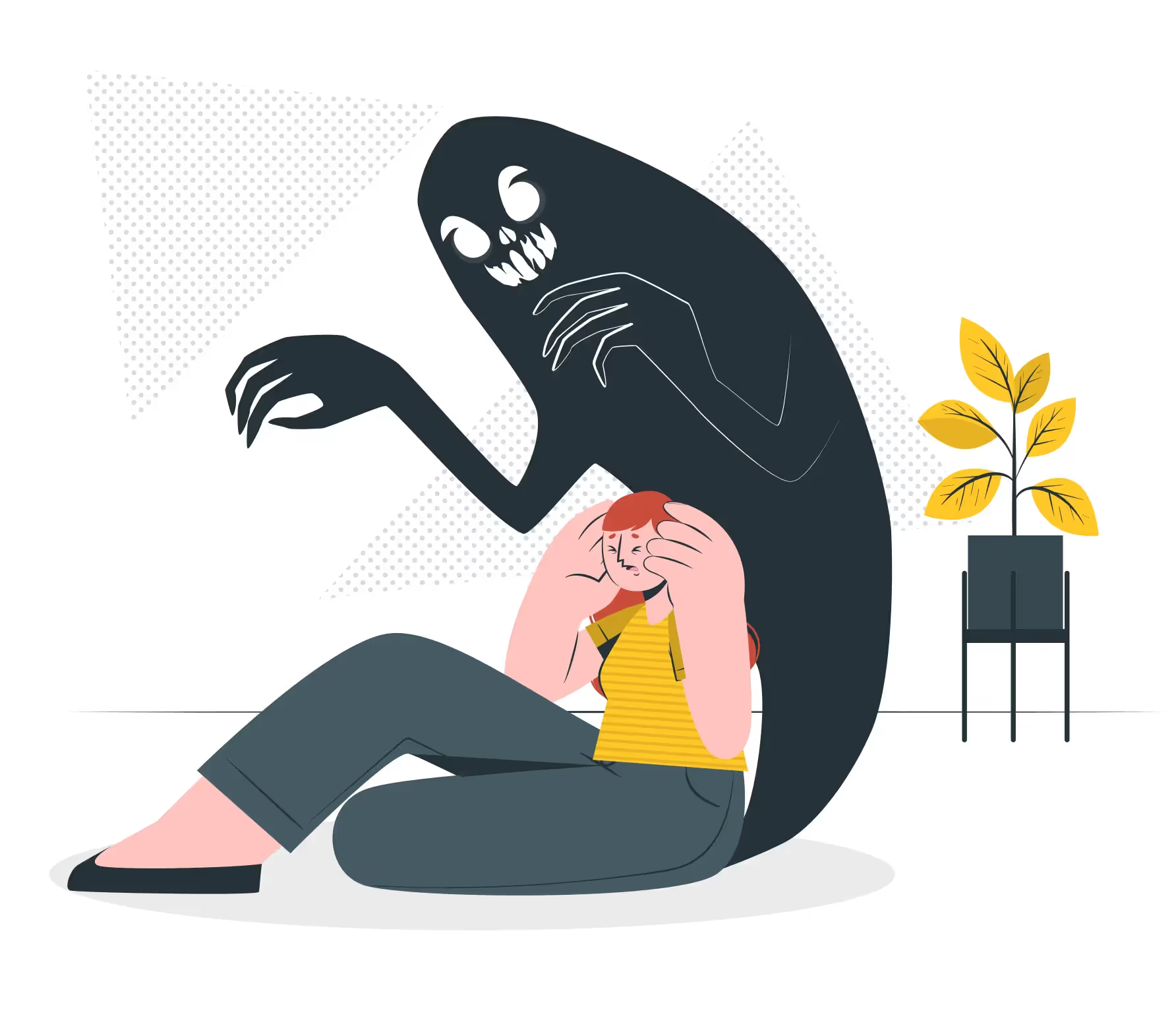
Of course. A hallucination is when a person perceives something that is not actually there. It can involve any of the senses — hearing, seeing, smelling, tasting, or feeling things that others cannot.
The most common type in schizophrenia is auditory hallucinations — that is, hearing voices.
The person may hear voices commenting on what they are doing, or two or more voices talking to each other, or even a voice commanding them to do something.
These experiences can be extremely distressing, especially because the voices often say unpleasant or threatening things.
What’s important to understand is that for the person experiencing them, these voices are completely real — as real as you and me talking now.
So telling them “this is not real” doesn’t help — it may, in fact, increase their distress or mistrust.
Delusions and Their Types
Host: And what about delusions — how do they differ from hallucinations?
Dr. Priya:
Delusions are false, firmly held beliefs that are not based on reality and cannot be changed even when there is clear evidence to the contrary.
For example, a person may believe that someone is constantly watching them, that they are being followed, or that people are plotting to harm them — these are persecutory delusions.
Another common type is delusion of reference, where the person believes that unrelated events or media messages (like a TV show or newspaper article) have a special, personal meaning for them.
Then there are grandiose delusions, where someone might believe they have special powers, are a famous person, or have a divine mission.
There are also nihilistic delusions, where the person believes something catastrophic has happened, like the world has ended or their organs have stopped working.
Each of these delusions can deeply affect a person’s behavior and relationships, depending on what they believe and how strongly they hold onto those beliefs.
Overlap Between Hallucinations and Delusions
Sometimes, hallucinations and delusions occur together and reinforce each other.
For instance, if someone hears a voice saying, “They’re coming to get you,” they may develop the delusional belief that people are plotting against them.
This combination makes it much harder for them to distinguish between what’s real and what’s not.
Cognitive Symptoms
Host:
The last—the third part of the symptoms—you mentioned about the cognitive symptoms. Cognition, from a common man’s understanding, is what I receive as information and how I process that information and how I respond with that information. So, in a person with schizophrenia, what has gone wrong? What part of this cognitive aspect is deranged?
Dr. Priya:
When we say cognition, it refers to what we call the higher brain functions — like thinking, judgment, reasoning, understanding, decision-making, problem solving, and planning.
What happens in schizophrenia is that it’s not overt cognitive deficits that we see, but rather subtle deficits.
It could start as early as a young age, but it’s picked up much later on when they come with psychosis.
Research studies have shown that cognitive deficits can start very early, even before the full-blown illness appears.
It could manifest as being “not very bright” or “not so good in studies,” not able to grasp things easily. Parents may think, “Oh, maybe his IQ is low,” but low IQ is different because in low IQ we expect other things like delayed physical or social development — which is not the case here.
In schizophrenia, it’s more about information processing and executive functions.
For example, if you give them information — say, “No actually, I’m not following you” — they may not be able to process that properly. Their attention and concentration are affected.
Some memory deficits are also there.
As the illness progresses — once the positive symptoms (like hallucinations or delusions) come down with treatment — the negative and cognitive symptoms become much more apparent and often more challenging to deal with.
Complexity of Diagnosis
Host:
When I read about schizophrenia in textbooks, I thought it’s a very simple and easy-to-understand illness. You started off saying positive, negative, and cognitive symptoms — so simple to diagnose.
But when you describe it, it looks very complicated. From a professional standpoint, it’s so challenging to identify and diagnose.
As a family member with no idea about this illness — when should I come to you?
Dr. Priya:
Like I said, it varies from individual to individual — how the illness manifests.
Sometimes, if they come only with negative symptoms, families don’t recognize it as a problem.
But now that they are watching this podcast or reading about schizophrenia, I hope they become more aware of such symptoms.
Some of the things families should look for include:
- Family history: If a family member — say, a son, brother, or uncle — already has schizophrenia, the risk in close relatives is higher.
- Early changes: Watch for subtle shifts in behavior, motivation, or communication.
- Prodromal phase: Before full-blown symptoms appear, there is often a vague early stage called the prodromal phase.
During this phase, the person feels that something is not right. Families may say, “He’s not himself,” but can’t pinpoint why.
Even clinicians sometimes find it difficult to recognize this phase because it’s so vague — it may involve slight withdrawal, mild self-talk, occasional muttering, or unexplained discomfort.
And then, sometimes suddenly — with or without a stressor — it can progress into full-blown schizophrenia.
So yes, if you come to us during this early phase, we can assess and guide you appropriately.
Age of Onset
Host:
Now, what is the age when schizophrenia starts? You mentioned the prodrome — when does that begin, and at what age does it usually appear?
Dr. Priya:
Actually, schizophrenia can occur at any age, but most commonly it starts in late adolescence and early adulthood — roughly between 18 to 35 years.
It’s quite rare in younger children, but if it appears before adolescence, it’s important to see a child and adolescent psychiatrist — much like how we’d see a pediatrician for child-specific issues.
When schizophrenia starts at a very young age, the prognosis (long-term outlook) tends to be less favorable — but treatment still helps a lot.
There’s also something called late-onset schizophrenia, which typically occurs after the age of 40, and this is slightly more common in women.
So, generally:
- Common onset: 15 to 35 years
- Late-onset: After 40 years
Families should be alert during the late teenage and early adult years — especially if someone starts isolating themselves, shows major personality changes, or becomes unusually aggressive without clear reason.
Range of Symptoms
Host:
So, a person with schizophrenia can have two ends of a spectrum — one end being overactive and aggressive, and the other being completely withdrawn?
Dr. Priya:
Yes, exactly.
They can present anywhere along that spectrum.
Some come with positive symptoms (like aggression, agitation, delusions), which often require immediate or emergency intervention.
Others may have mostly negative symptoms — the ones who are withdrawn, not talking, not working, staying in their room, lacking motivation.
And some have both positive and negative symptoms — where we may first notice the psychotic behaviors, and later, as treatment stabilizes, the negative symptoms become more visible.
Early Recognition and Family Awareness
Host:
So, when families find that someone is acting out of the ordinary — very unusual behavior, isolating, or angry for small reasons — that’s when they should start getting alert?
Dr. Priya:
Absolutely.
It’s all about recognizing when behavior is out of character for the person.
For example, a young person who was previously cheerful and social suddenly becomes withdrawn, irritable, or suspicious — that’s a red flag.
Families often think it’s just “stress,” “puberty,” or “laziness,” but sometimes it’s more than that. Early intervention makes a big difference.
Medical Investigations and Differential Diagnosis
Host:
Now, one last question about the diagnosis. I read about a case in the US where a man committed violent acts and later it was found he had a brain tumor pressing on the amygdala — the area responsible for aggression and emotion.
That made me wonder — when people come to you with symptoms like aggression or hallucinations, what do you do to make sure it’s not caused by something physical, like a brain tumor?
Dr. Priya:
That’s a very important question.
Like I mentioned earlier, before confirming schizophrenia, we must rule out all physical causes that could lead to similar symptoms.
So, we follow a two-step diagnostic process:
- Rule out physical and organic causes
- Brain tumor
- Stroke
- Seizure disorders (like temporal lobe epilepsy)
- Parkinson’s disease or other neurological conditions
- Substance or drug-induced psychosis
- Severe metabolic or hormonal imbalances
- Clinical assessment for schizophrenia
- Based on symptoms, duration, and exclusion of other conditions.
To do this, we conduct investigations, such as:
- Blood tests: To check for infections, thyroid issues, liver/kidney function, vitamin deficiencies, or metabolic causes.
- Urine drug screen: To detect substance use — cannabis, LSD, cocaine, etc.
- Neuroimaging (CT or MRI): Especially in the first episode of psychosis, to rule out structural abnormalities like tumors or lesions.
- EEG: If seizures or temporal lobe epilepsy are suspected.
These tests also give us a baseline before starting medications, so we can monitor effects and side effects safely.
So, it’s not just that a person says, “I’m hearing voices,” and we give them antipsychotics.
We go through a systematic evaluation to ensure we’re not missing a physical illness masquerading as schizophrenia.
Summary
Dr. Priya:
So, in summary — schizophrenia is a serious but treatable mental illness.
It involves a complex mix of positive, negative, and cognitive symptoms, which affect the way a person perceives reality and functions in life.
Early recognition, proper medical evaluation, and consistent treatment — including medications, psychotherapy, and rehabilitation — can help individuals recover and lead fulfilling lives.
Our Centres


.webp)
.jpg)

-min.webp)

.jpg)
.avif)