The De-Addiction – The Ray of Hope to Recover

Mr.Rajashekhar Hiremath

Director-Operations


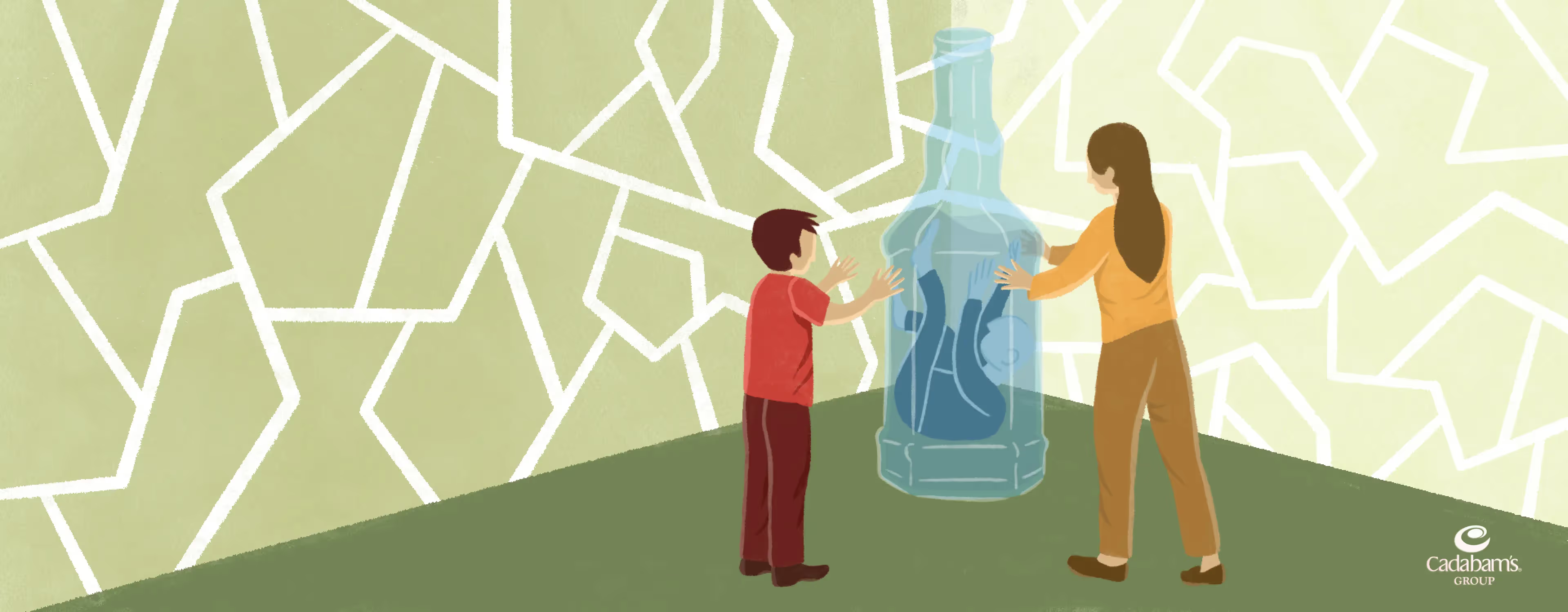
The Addiction or Abuse of Alcohol, tobacco and other drugs is a huge problem all over the world. Even more so with developing countries, the impact of poverty rapid socio-cultural change and lack of treatment further compounds the problem. Among non-communicable diseases, alcohol and drug abuse are disorders associated with significant disability. The abuse of substances is not a problem just for user. It creates tremendous emotional and economical pressures for family members. Even though it is very clear that there are several health related problems with the problem use of alcohol & substance, there are little effective interventions that occur for early stage problems. The scenario is similar for tobacco and illicit drug. Alcohol & drugs are ingested by many around us to have fun, as a remedy for emotional & stress full problems to be part of a group, to feel good, to feel happy & much more reasons without knowing that every 20 out of these 100 become dependent on it.

What is Substance addiction or dependence?

Alcoholism and drug dependence and addiction, known as substance use disorders, are complex problems. Substance use disorder is an illness that can affect anyone: rich or poor, male or female, employed or unemployed, young or old, and any race or ethnicity. Nobody knows for sure exactly what causes it, but the chance of developing a substance use disorder depends partly on genetic, biological traits passed down through families. A person’s environment, psychological traits, and stress level also play major roles by contributing to the use of Alcohol or drugs. People with these disorders once were thought to have a character defect or moral weakness; some people mistakenly still believe that. However, most scientists and medical researchers now consider dependence on alcohol or drugs to be a long-term illness, like asthma, hypertension (high blood pressure), or diabetes. Most people who drink alcohol drink very little, and many people can stop taking drugs without a struggle. However, some people develop a substance use disorder—use of alcohol or drugs that is compulsive or dangerous (or both). One of the most important signs of substance addiction or dependence is continued use of drugs or alcohol despite experiencing the serious negative consequences of heavy drug or alcohol use. Often, a person will blame other people or circumstances for his or her problems instead of realizing that the difficulties result from use of drugs or alcohol.

Physiological & Psychological phenomena induced by the repeated taking of a substance.


  • Strong desire to take the substance.
  • Difficult in controlling substance taking behavior.
  • A physiological withdrawal state.
  • Development of tolerance
  • Progressive neglect of alternative pleasures or interest.
  • Persisting with substance use despite clear evidence of harmful consequence.
  • Important social, occupational or recreational activities are given up or reduced because of substance use.
  • Recurrent substance use resulting in a failure to fulfill major role obligations at work, home & society.
  • Recurrent substance use in situations in which it is physically hazardous
  • Recurrent substance-related legal problems(Eg.Arrest for substance –related disorderly conduct)
  • Continued substance use despite having persistent or recurrent social or interpersonal problems caused or exacerbated by the effect of the substance.
  • Sever  maladaptive patterns of substance use that impairs health in a broad sense


Common Substance Dependence or Abuse


  • Alcohol
  • Cannabis/Marijuana/Hashish/Brown sugar
  • Tobacco
  • Heroin
  • Opium
  • Cocaine
  • LSD
  • Amphetamine
  • Phencyclidine
  • Barbiturates,Benzodiazepine,carbamates(Sedative & Hypnotics)
  • Inhalants
  • Caffeine.
  • Minor tranquilizers


De-addiction centers should have exclusive facilities to enabling these unfortunate including incidental addicts to Reckon, Relinquish & Recover completely to lead an independent normal life which they had before developing dependency.

WHAT IS SUBSTANCE ABUSE TREATMENT?

Most treatment programs assign patients to a treatment team of professionals. Depending on the type of treatment, teams can be made up of psychiatrists, clinical psychologists, doctors, De-addiction specialist, social workers, Counselors, nurses or other professionals.

Treatment and Planning Psychosocial Interventions.

A) Assessment: A full assessment, including an appraisal of current medical, psychological and social problems is initial assessment everyone entering treatment receives a clinical assessment. A complete assessment of an individual is needed to help treatment professionals offer the type of treatment that best suits him or her. The counselor needs to get a full picture of the problem; the assessment also helps program counselors’ work with the person to design an effective treatment plan.

B) Biomedical modalities: Focus on improved Detoxification regimens for treatment of withdrawal symptoms, such as mild tremors,nausea, vomiting, weakness, irritability, insomnia,  anxiety   & shakiness and Delirium tremens such as clouding of  connsciousness, disorientation, poor attention span, vivid hallucination,Delusions, Psychomotor agitation and dehydration. The person may try to relieve these symptoms by taking either more of the same or a similar substance. Detoxification dependents on specific drug used, the total daily amount, multiple dependence,       Duration and regularity of use, Psychological factors. During this time the client may complete medical management to come out of such withdrawals. It may take several days to a week or more.

C) Psychosocial Treatment modalities: Range from addiction counseling  to  psychodynamic and cognitive behavior treatment modalities, insight-oriented psychotherapy, behavior therapy including aversion conditioning, family, group& individual counseling   and therapies, Narco & Hypno-Therapy and systematic motivation enhancement therapy (MET).Relapse prevention techniques.  Group and Individual Counseling, It has its own value in the treatment At first, individual counseling generally focuses on motivating the person to stop using drugs or alcohol. Treatment then shifts to helping the person stay drug and alcohol free. The counselor attempts to help the person See the problem and become motivated to change, Change his or her behavior, Repair damaged relationships with family and friends, Build new friendships with people who don’t use Alcohol or drugs Group counseling is different in each program, but group members usually support and try to help one another cope with life without using drugs or alcohol. They share their experiences, talk about their feelings and problems, and find out that others have similar problems. Groups also may explore spirituality and its role in recovery.

D) Socio-cultural treatment modalities: Include the community reinforcement approach, occupational & vocational rehabilitation and culturally specific interventions. Education About Substance Use Disorders People learn about the symptoms and the effects of alcohol and drug use on their brains and bodies. Education groups use videotapes or audiotapes, lectures, or activities to help people learn about their illness and how to manage it. Encouraging clients to participate self-help groups in self-help groups support and encourage one another to become or stay drug and alcohol free. Twelve-Step programs are perhaps the best known of the self-help groups. These programs include Alcoholics Anonymous (AA), Narcotics Anonymous (NA), Cocaine Anonymous, and Marijuana Anonymous. Other self-help groups

E) After Care: Follow-up Care (Also Called Continuing Care) Even when a person has successfully completed a treatment program, the danger always exist getting relapse systematic follow-up and member of AA/NA may help to sustain for getting relapse.

Finally No one can predict client will recover, or for how long, but many people who receive treatment do get better. The longer people stay in treatment the more likely they will remain drug and alcohol free. The reason for staying away from home not only to keep away from such stimulating environment, should have purpose to deal specific issues relating to his addiction. About half the people who complete treatment for the first time continue to recover. Of course, this means that some percentage people take chance and they may make relapse is the part of recovery and sought immediate help of the professionals or within a short period they may recover themselves after understanding the ill affect of such relapse & some will return to drinking alcohol and using drugs before they finally give them up for good but De-addiction programmes always give individuals a Ray of Hope to get recover.

Genes May Also Affect Severity of Drug Addiction a New Case Study

Treatment for drug addiction is affected by a person’s genetic makeup and the duration of substance abuse.

A research team found that drug addicts who have a certain genetic makeup have lower gray matter density — and therefore fewer neurons — in areas of the brain that are important for decision-making, self-control, learning and memory.

This research shows that genes can influence the severity of addiction. ” The results suggest that addicted individuals with low MAOA [monoamine oxidase A] genotype may need a different kind of treatment than other addicted individuals who carry the high MAOA genotype.”

However, addiction treatment professionals and others who manage addicted individuals, such as probation officers and judges, should be informed of these and other new findings in the neurobiology of drug addiction.

The study, which included 40 men addicted to cocaine and 42 non-addicted men, also found that the longer someone abuses cocaine, alcohol and cigarettes, the lower the amount of gray matter in frontal areas of the brain (responsible for decision-making and self-control) and the hippocampus (responsible for learning and memory).

The finding, suggests that ending drug use may help protect people against such brain changes.

Only males were part of this study, and therefore it is important for future studies to examine these genetic and brain effects in females as well. Also, further studies will have to be done to track these gene-brain behavior patterns throughout a life span that influence the volume of the brain’s neurons.

Study On Children’s Mental Health Related to Class Room Environment

Children in classrooms with inadequate material resources and children whose teachers feel they are not respected by colleagues exhibit more mental health problems than students in classrooms without these issues, finds a new study in the March issue of the Journal of Health and Social Behavior.

Sociologists and other researchers spend a lot of time looking at work environments and how they are linked to the mental health of adults, but we pay less attention to the relationship between kids’ well-being and their ‘work’ environments – namely their schools and more specifically their classrooms. This research shows that the classroom environment really matters when it comes to children’s mental health.

According to the study, Classroom Learning Environments and the Mental Health of First Grade Children, policymakers typically measure school quality and teacher effectiveness in terms of academic outcomes such as test scores. But, their study demonstrates that schools and teachers also impact children’s mental health, making it a barometer that deserves more attention.

Parents care a lot about their children’s mental health – their emotional and behavioral well being – but we as a society don’t tend to focus on that as an important educational outcome nearly as much as we talk about and think about academic outcomes.

The study relies on a nationally representative sample of approximately 10,700 first graders, whose parents and teachers were interviewed.

As part of their study, the authors considered how the classroom environment impacted four components of mental health: learning (e.g., attentiveness), externalizing problems (e.g., fights), interpersonal behavior (e.g., forming friendships), and internalizing problems (e.g., anxiety and sadness).

Children in classrooms with inadequate material resources and children whose teachers felt their colleagues did not respect them experienced worse mental health across all four measures.

The material resources ranged from basics such as paper, pencils, and heat to child-friendly furnishings, computers, musical instruments, and art supplies.

Being in a classroom with a lack of resources might adversely impact children’s mental health because children are frustrated or disheartened by their surroundings. Teachers also may be more discouraged or harsh when they can’t teach properly due to the fact that they are missing key elements.

Regarding children whose teachers felt their colleagues did not respect them, There is an adverse trickle down effect on students.

For teachers to get the support and encouragement that they need from colleagues, including the principal, is likely important for whether the teachers are able to create a classroom climate that helps children thrive. If teachers are feeling stressed out because they aren’t getting what they need from their colleagues, that stress may carry over to the kids.

How to Predict the Drug Usage in your Teen

Even if your teenagers do not use drugs, you still need to keep an eye on them. It is much better to realize that things could change, and anticipate that your teen COULD become a user. Essentially, it is not wise to make assumptions about topics such as drug use. Also, having been a high school teacher afforded me the opportunity to witness peer pressure, and how even good kids could be convinced to try drugs – just to fit in. It is important that you play a proactive role in ensuring that your teenagers and the rest of your family remains drug free.

About drug use

Initially, I learned that the signs of drug use included three basic symptoms:

  • A loss of interest in hobbies
  • A change in friends
  • A drop in grades

What I later discovered was that not seeing these symptoms only provides a false sense of security regarding teenagers and potential drug use. The above behaviors apply more to signs of “drug addiction,” as opposed to “experimental” drug use.

Teens who experiment with drugs don’t start out addicted so logically, they do not show any symptoms. They generally look healthy and nothing seems to be wrong. In fact, teens can casually use drugs for over a year before their parents would even suspect any drug or alcohol use.

Many teenagers who decide to experiment with drugs start out casually, using them with friends and then progressing towards regular use. It is important that you look for clues pertaining to casual drug use so that if your teen is prone, you can proactively deal with it.

What you can do

You need to monitor your teen’s behavior and watch for signs of drug use, without appearing to be spying. Your goal should be to prevent him or her from feeling free to experiment with drugs or alcohol. The best way to accomplish this is to keep abreast of your teen’s activities and friends. You will be able to spot a problem early if you keep your eyes and ears open, and believe that YOUR teenager is capable of using drugs. Many parents get blind-sided by thinking that their teen would never try drugs. Only then will you be ready to intervene if the situation presents itself.

The following are ten ways to monitor your teenager’s behavior and watch for signs of drug use, without appearing to be spying:

1. Hug your teen as soon as s/he arrives home. Check for odors of possible marijuana smoke or alcohol. Remember that cologne or chewing gum may be used to hide the odor.

2. Teenagers under the influence will usually go straight to their room when they arrive home. While making eye contact, hold a brief conversation. Check for bloodshot eyes, slurred speech and their sense of balance.

3. Keep the lights on and stay up until your teenager comes home.

4. Ask your teen for the time and watch the way s/he looks at his or her watch.

5. If your teenager unexpectedly wants to spend the night at a friend’s house, and you have concerns, say no.

6. Maintain a flexible schedule. Be unpredictable so your teen cannot find it easy to plan around your activities.

7. Keep abreast of what your teen is really doing when away from home. Meet their friends and their parents and participate in mutual activities. This is a very effective form of networking.

8. Ask your neighbors to discretely keep an eye on any activities that may take place while you are not home.

9. Check to see how your teens are doing in school. Ask their teachers if there is any cause for concern or if your teen has been behaving differently.

10. After you meet your teenager’s friends, always ask them to identify themselves when they call. Get to know them. Always encourage your teens to invite their friends over while you are home.

Remember, your goal should be to prevent your teenager from feeling free to experiment with drugs or alcohol. The best way to accomplish this is to keep abreast of their activities and friends using the above methods.

Lastly, but most important, talk to your teenager on a regular basis about the drug use she witnesses, and how she feels about it. Also, if she has been approached, have her describe how she handled the situation. Strive for honesty and ask how you can help her to remain drug free.

Drug Rehabilitation Facts and Treatment

Drug addiction is one of the major concern that most of the people are struggling with so many years around the globe. People who are addicted to any sort of drug not only ruins the addicts life but also puts bad impact on family, relatives, friends and all the people around them. This is something which should not be taken as lightly because any delay in the treatment can be very devastating and sometimes may result into death. For them one of a better and an appropriate way to come out from this vicious circle is going for drug rehab treatment at Cadabams in Bangalore. Here are some vital information about the drug addiction as well as effective treatment programs that will certainly help you in finding a best one for loved ones.

One of the bitter truth about this life threatening disease is millions of people get addicted to drugs and thousands of them die every year without getting proper treatment. Therefore, if there is anyone suffering from any sort of drugs, then treatment should always be a goal. Whether the addicts is dependent on pain killers, street drugs, alcohol or many others substance there is a suitable way to kick this habit. One of the better and effective way to get rid of this habit is to send them to a drug rehabilitation center at Cadabams in Bangalore. These treatment center help them in staying away from day-to-day issue and offer suitable rehabilitation programs and allows them to get better. With the help of professionals they offer treatment programs which cover physical as well as psychological behavioral of the patients.

Most of the treatment center offers detoxification as the first and foremost step of treating patients. In this two to three weeks rehabilitation program, professionals and support staff try to eliminate the toxic materials from the body of addicts with the help of suitable medicines. These professionals and support staff are always ready in handling any challenges during this program because usually patients show severe withdrawal symptoms. It is highly recommended that detoxification programs should be carried under the trained and qualified professionals because there is possibility of relapses if it is not handled with care. Detoxification is one of a sure shot method used most of rehabilitation center at Cadabams in Bangalore, because they make patient ready for other treatment program. Once the patient is detoxified they have options to choose between outpatient and inpatient treatment programs (known as residential treatment).

The inpatient treatment is suitable for those patients who are suffering from serious addiction or already have a history of substance abuse. Depending upon nature of addiction this rehabilitation program could last from six to twelve months or may be extended if needed. And intensive outpatient treatment programs are suitable for those who are suffering from mild addiction. In this programs, patients have to visit the therapy center frequently so that proper medication and treatment should be given.

Mental Illness Breaking News: Fish Oil Prevents Mental Disorders

NaturalNews has already reported on the amazing array of health advantages linked to a diet rich in omega-3 fatty acids, a “healthy” fat found in certain foods such as salmon and walnuts. For example, researchers have documented that omega-3s can help prevent heart arrhythmias and treat depression. These fatty aacids also appear to have an antiaging effect on cells. Get ready to add another remarkable benefit to the list of omega-3 benefits: now scientists have found fish oil supplements containing omega-3s may stop people at high risk for severe mental illness from becoming psychotic.

Psychotic disorders such as schizophrenia are devastating forms of mental problems in which people lose contact with reality and can end up, in worst case scenarios, hurting themselves and others. According to the National Institutes of Health (NIH), a psychosis is usually characterized by delusions and seeing or hearing things that aren’t there (hallucinations). The treatment is primarily heavy duty, side effect riddled psychiatric drugs and/or institutionalization.

But what if people a high risk for this mental illness could be prevented from having a psychotic disorder in the first place? That may be possible, thanks to omega-3 fatty acids.
Omega-3s prevent psychotic disorders
According to a report just published in the February issue of Archives of General Psychiatry, people at extremely high risk of developing a psychosis were found to be less likely to develop psychotic disorders after just 12 weeks of taking fish oil capsules containing omega-3 fatty acids. The study authors pointed out that omega-3 supplementation may be effective because individuals with schizophrenia have an underlying dysfunction in fatty acid metabolism.

“Early treatment in schizophrenia and other psychoses has been linked to better outcomes…intervention in at-risk individuals holds the promise of even better outcomes, with the potential to prevent full-blown psychotic disorders,” the authors wrote in their article.

G. Paul Amminger, M.D., of the Medical University of Vienna, Austria, and Orygen Youth Health Research Center in Melbourne, Australia, headed a randomized, double-blind, placebo-controlled clinical trial to test whether omega-3s could influence the risk of progression to psychosis in 81 individuals considered to be at extremely high risk for the disorder. The research subjects had displayed a decrease in their ability to function and they also had already developed mild psychotic symptoms, transient psychotic episodes and/or they had a family history of psychotic disorders. Those criteria, the researchers stated in their study, are used to identify individuals whose risk of becoming psychotic may be as high as 40 percent over the course of a year.

For about three months, 41 of the research subjects were given daily fish oil capsules containing 1.2 grams of omega-3 polyunsaturated fatty acids. The other 40 participants were given a placebo. When the study ended, about 94 percent of the subjects were still in the study and two taking the omega-3s, or only 4.9 percent, had developed a psychotic disorder. On the other hand, 11 in the placebo group (27.5 percent) had become psychotic. The difference between the two groups was extraordinary — 22.6 percent.

What’s more, supplementation with the fatty acids significantly reduced mental illness symptoms and improved overall functioning, too. Not surprisingly, there were virtually no side effects associated with the fish oil pills.

“The finding that treatment with a natural substance may prevent or at least delay the onset of psychotic disorder gives hope that there may be alternatives to antipsychotics for the prodromal (early symptomatic) phase. Stigmatization and adverse effects — which include metabolic changes, sexual dysfunction and weight gain — associated with the use of antipsychotics are often not acceptable for young people,” the scientists wrote in their study. “Long-chain omega-3 fatty polyunsaturated fatty acids reduce the risk of progression to psychotic disorder and may offer a safe and efficacious strategy for indicated prevention in young people with subthreshold psychotic states.”

Angry is a Part of Mental illness, Latest Psychiatric Study

NaturalNews Proposed updates to the Diagnostic and Statistical Manual of Mental Disorders (DSM) are prompting many to question whether or not the psychiatric profession itself has gone crazy. The latest additions to the alleged “mentally ill” could include hoarders, people who get angry every now and again, lazy people, and even those who get outraged over things like sex and violence on television.

Since its first publication back in 1952, the DSM has grown exponentially larger with each subsequent edition. Many people are lambasting the American Psychiatric Association (APA) for trying to establish virtually all behavior as some sort of mental disorder that should be treated with psychiatric drugs.

“For this latest revision they’ve set up a special task force to decide if behaviors like bitterness, extreme shopping or overuse of the internet should be included,” explained Professor Christopher Lane to a reporter from the the U.K.’s Daily Mail. “The science underlying all this is very shaky to non-existent.”

Dr. David Kupfer, chairman of the APA’s special task force, has come out in defense of the additions. He claims that each one is grounded in science, despite the fact that no biological markers can definitely identify any of the additions as actual disorders. In order to identify things like excessive shopping and extreme laziness as mental disorders, the team will simply call them as such and provide a description of the each one’s symptoms.

If the additions themselves are not loony enough, the APA is actually recommending the inclusion of what it calls “risk syndromes”, or early warning signs that could lead to one of its supposed mental disorders. By catching these “risk syndromes” early, doctors can begin prescribing medication for conditions that people do not even have.

The entire DSM charade is a ploy to characterize an ever-increasing segment of the population as being “sick” and in need of pharmaceutical drugs. There can be no variations in personality and individual characteristics; if a person does not live, think, and react in prescribed fashion, then he or she is sick and in need of treatment, according to the APA.

The latest DSM draft, which is set to be published in 2013, has already been posted on the internet for public viewing. Since being posted, there has been widespread outcry against many of the proposed additions. It remains to be seen what will be included in the final edition and whether or not people will continue to take the DSM and the APA seriously.

Fighting Drug Addiction By Taking Help From Best Rehab Centers

Fighting drug addiction takes courage, strength, and support. It is almost impossible for a drug addict to battle drug addiction…
Because drug addiction robs you of your strength and makes you weak… drug addiction destroys your relationships…and drug addiction makes you afraid and insecure.
You might not feel like you deserve a better life—but you do.
A drug rehabilitation center will help you rebuild confidence in yourself. By including friends and family members in the counseling program, you will also find the right kind of support you need both during and after your rehab treatment.
Finally, drug rehabilitation helps you find the strength it takes to overcome drug addiction. In many ways, you will become stronger than you were before drugs took control of you.
v Detox
The first step of drug rehabilitation is detoxification. This vital step is important because all chemicals that remain from drug abuse must be eliminated from the body. These toxins maintain a physical control over a drug user, and until they are completely cleanses… you will not be ready to recover from addiction or to participate in any of the rehabilitation programs.
v Healthy Diet
Drug rehab centers provide all patients with 3 nutritious meals a day. Physically, you will become more capable of handling stress, and will be feeling more energetic and motivated.
v Counseling
Drug rehabilitation includes a variety of counseling programs, each designed to work together while providing individual benefits.
ü Group Counseling provides each patient with an opportunity to connect with peers, all struggling with addiction and recovery from addiction, to recognize common challenges and work together to find realistic ways to overcome these triggers. This form of counseling will help each patient be stronger, socially, when the opportunity to relapse presents itself.
ü One on One Counseling is more personal counseling. Each individual patient has his or her own unique challenges and triggers. Often, drug addiction comes from an underlying disorder (such as depression or anxiety) and in order to be strong enough to recover from addiction… one must also treat any underlying disorders. Facing these obstacles will help each individually become a stronger person, mentally, and to be prepared for the battle of recovery from drug addiction.
ü Family Counseling will help educate both the patient and loved ones (friends or family members) of the patient about drug addiction. This form or counseling is very beneficial to the relationships that matter, as ongoing support is important for recovery from alcohol addiction. Family counseling ultimately strengthens the relationships that have been affected by addiction.

Read more: Visit here for original post

Latest Addiction Rehab and Treament News

The two major drugs of abuse in our society –opioids (heroin) and cocaine –exert their addictive properties through two different neurotransmitter systems in the brain. Therefore, it has been assumed that pharmacologic treatments for cocaine or heroin abuse would have to be different, even though the concurrent abuse of both drugs is very common.

Opium now a medication originally developed as a pain reliever has shown great promise for the treatment of “polydrug” abuse involving both cocaine and opioids. This drug, called buprenorphine, is unusual in that it both activates and inactivates the molecules (called receptors) where opiates attach on the nerve cells in the brain. Thus, like most opioids, it effectively relieves pain but the risk for overdose is minimal.

The Granger Collection, New York. Clinical studies found buprenorphine to be effective as a treatment for heroin addiction and to have some advantages over methadone in terms of relative safety. However, a surprise was that buprenorphine was also found to reduce cocaine abuse in individuals who are dependent on both heroin and cocaine. Finding these dual effects by buprenorphine provides new insights into the mechanisms of cocaine and heroin dependence and suggests that these mechanisms may be more related than was previously thought.

EFFECTIVE WAYS TO GO FOR REHABILITATION CENTERS

There are several treatment centers which provide treatment programs for the inpatient as well as for the outpatient. Inpatient treatment program are suitable for those patients who are looking to get rid of severe addiction.
If you are looking up for a drug addiction treatment for yourself or your dear ones in India then you have to make lots of consideration. First you have to find a best treatment center which provides treatment programs for drugs addicts. Many people think that enrolling in drug rehab center and waits for them to come over the drug addiction completely. If someone is going for drug Rehab , addicts, family members and the treatment provider need to be patience because the recovery will take some time. Treatment programs provided by these rehab centers are designed in such way that it suits addicts. Detoxification is the first step of treatment to the addicts who enroll in rehab center. In this process, toxic materials are removed from the body of addicts with the help of various medicines. So, it is always better to spend some time in finding a suitable and appropriate center for your near and dear ones
Here are some descriptions which will helps you finding a drug rehab center.
1. Make sure that the treatment center you are selecting for drug treatment offers the kinds of treatment programs which you needs. Because there are ample numbers of treatment center which offers conventional medicinal programs and holistic treatment programs.

2. Before enrolling in treatment center always check that whether the center is approved by the government or not. One of the best ways to check is visiting the substance abuse website of the state or the treatment center website. Also make sure that the kind of treatment program they are offering are deemed as qualified within the India.

3. Another important thing which has to be checked is the reputation of the treatment center which includes the kind of license that center has. A licensed treatment center always provides best treatment that means that an external organization has checked the programs and found it useful to the addicts.

4. Also check that the kind of treatment facilities the center provides. The treatment programs offers to you or your near ones much have detoxification program in order to cut down the desire of substance abuse.

Apart from these, there are several treatment centers in Rehabilitation India which provide treatment programs for the inpatient as well as for the outpatient. Inpatient treatment program are suitable for those patients who are looking to get rid of severe addiction. Patients have to stay in residential setting in order to detox under the supervision of professional. Then patients go through various therapies and counseling classes which are given by these professionals. And outpatient treatment program are for those who have gone through the long treatment earlier. In this case patients don’t have to stay in the treatment center. Patients have to visit the treatment center frequently in order to get medication and treatment.And outpatient treatment program are for those who have gone through the long treatment earlier. In this case patients don’t have to stay in the treatment center. Patients have to visit the treatment center frequently in order to get medication and treatment.

Subscribe: Entries | Comments

Copyright © Cadabam's Blog 2012 | Cadabam's Blog is proudly powered by WordPress and Ani World.